
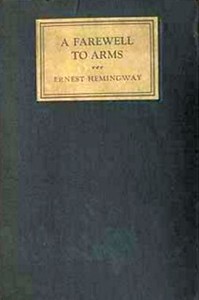
Ernest Hemingway served as a Red Cross ambulance driver in Italy in 1918, was wounded near Fossalta, and fell in love with his nurse Agnes von Kurowsky. She later broke off their relationship by letter. He spent the next decade processing what happened, and in 1929 published A Farewell to Arms — the great American novel about World War I.
It took him five years and forty-seven endings.
Open A Farewell to Arms in warpread →
What A Farewell to Arms Is About
Frederic Henry, an American officer with the Italian ambulance corps, is stationed in northern Italy in 1917. He is wounded by a mortar shell, transported to a hospital in Milan, and falls in love with Catherine Barkley, a British nurse.
They have months together in Milan — the summer of 1917, while Henry recovers. Then he returns to the front. The Italian army begins its catastrophic retreat from Caporetto. Henry survives the retreat, escapes summary execution at the Tagliamento River, and makes his "separate peace" — deserting from a war he no longer believes in.
He finds Catherine again at Stresa. They row across Lake Maggiore to Switzerland in the rain. They are safe.
In Switzerland, Catherine becomes pregnant. The birth goes wrong. She dies. The baby dies. Henry walks back to the hotel in the rain.
How Long Is A Farewell to Arms?
| Reading speed | Time to finish |
|---|---|
| 200 WPM | ~6.2 hours |
| 250 WPM (average) | ~4.9 hours |
| 350 WPM (practised) | ~3.5 hours |
| 500 WPM (RSVP) | ~2.5 hours |
Reading Strategy
Book I (The Front) — establishment of character, the front, the wound. Use warpread's RSVP mode at 350–400 WPM. The Italy described here is vivid but the pace is patient.
Book II (Milan) — the romance and recovery. The most emotionally relaxed section of the novel. Read at 350 WPM; this is where Hemingway's tenderness is most visible.
Book III (Caporetto) — the retreat. One of the great sustained action sequences in war fiction. 400 WPM. The execution scene at the Tagliamento demands full attention.
Books IV–V — Switzerland, the birth, the ending. Slow down progressively. By the final five pages, read at 200 WPM. The ending earns the slowness.
Hemingway's prose in RSVP — short, declarative sentences work exceptionally well at pace. Don't slow down for simple sentences; they carry more at speed.
For the full speed reading technique, see how to read faster.
Where to Read A Farewell to Arms Free
- warpread library — instant reading, RSVP mode, no account needed
- Project Gutenberg — complete text, EPUB and download
- Standard Ebooks — best-formatted free EPUB
More Hemingway and WWI in the Library
- The Sun Also Rises — the Lost Generation after the war
- Mrs Dalloway — Woolf's parallel examination of post-WWI consciousness
- All Quiet on the Western Front — Remarque's German perspective on the same war
For the full list of free classics, see the 50 best free classic novels to read online.
Continue Reading
If you enjoyed this guide, here are the best next steps:
Read A Farewell to Arms free in warpread.app →
For tips on building reading speed with books like this, see How to Speed Read: 7 Proven Techniques — covering RSVP practice, subvocalisation reduction, and how to track your progress.
If you're looking for more books at a similar level, warpread's free library has 70+ public domain classics ready to read in your browser, organised by author, genre, and difficulty.
Topics
Frequently asked questions
Is A Farewell to Arms free to read online?
Yes. A Farewell to Arms was published in 1929 and entered the public domain on 1 January 2025 in the US. You can read it free at warpread.app's library (Project Gutenberg ID 75201), Standard Ebooks, and many other sites — no account, no download, no payment.
How long does it take to read A Farewell to Arms?
A Farewell to Arms is approximately 74,000 words. At 250 WPM it takes about 4.9 hours. At 350 WPM around 3.5 hours. At 500 WPM with RSVP reading, about 2.5 hours. One of the most readable Hemingway novels — the prose is stripped but the story carries you.
What is A Farewell to Arms about?
Lieutenant Frederic Henry is an American serving as an ambulance driver with the Italian Army in WWI. He is wounded and falls in love with Catherine Barkley, a British nurse. As the Italian front collapses after Caporetto, Henry deserts and the two flee to Switzerland. The novel is about war, love, loss, and the question of whether anything can be preserved from the chaos of history.
What is the famous ending of A Farewell to Arms?
Catherine dies in childbirth, and the baby is stillborn. Frederic Henry is left alone: 'It was like saying good-by to a statue. After a while I went out and left the hospital and walked back to the hotel in the rain.' Hemingway wrote 47 different endings to the novel before settling on this one. The restraint of the prose — no emotional display, just the rain and the walk — is the ending's power.
How does A Farewell to Arms compare to The Sun Also Rises?
A Farewell to Arms is more plot-driven and more directly emotional than The Sun Also Rises. The Sun Also Rises operates almost entirely through subtext; A Farewell to Arms is more openly romantic. Many readers find Farewell to Arms more immediately moving; many critics prefer the formal control of The Sun Also Rises. Both are masterworks of the same style.
Is A Farewell to Arms anti-war?
A Farewell to Arms depicts war as chaotic, pointless, and deadly — the Italian retreat from Caporetto is one of the most devastating anti-war sequences in fiction. But Hemingway is not writing a political argument; he is describing experience. Henry's desertion ('I had made a separate peace') is not a moral position so much as a survival instinct. The war doesn't end in the novel; it simply stops mattering to Henry because Catherine is more real to him than any cause.
Ready to apply these techniques?
Take the free reading speed test to benchmark your WPM and get personalised technique suggestions.