
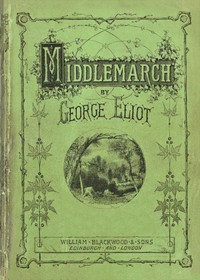
"One of the few English novels written for grown-up people." Virginia Woolf wrote this about Middlemarch in 1919, and the judgement has held for over a century. What Woolf meant: Eliot does not simplify. Her characters are morally complex; their failures come from genuine virtues as much as genuine flaws; the world they live in is resistant to good intentions in ways that cannot be resolved.
Middlemarch is 316,000 words. It is the greatest Victorian novel.
Open Middlemarch in warpread →
What Middlemarch Is About
Four storylines, interwoven:
Dorothea Brooke — brilliant, idealistic, and living in a world that offers her no outlet for her capabilities. She marries the elderly scholar Edward Casaubon, believing she can help his great work. The work is hollow; the marriage is a catastrophe; the question is what she does next.
Tertius Lydgate — a young doctor with genuine talent and reforming ambitions, who marries the beautiful and conventional Rosamond Vincy and watches his professional dreams erode under financial and social pressure.
Fred Vincy — Rosamond's brother, feckless and in debt, in love with Mary Garth who refuses to marry a man who wastes himself. His arc is one of the quietest and most satisfying in the novel.
Nicholas Bulstrode — a powerful banker and Evangelical hypocrite, whose secret past is about to surface.
George Eliot's narrator moves through all four stories with extraordinary intelligence, analysing motivations, providing historical context, and occasionally stepping back to deliver some of the most penetrating observations about human psychology in Victorian fiction.
How Long Is Middlemarch?
| Reading speed | Time to finish |
|---|---|
| 200 WPM | ~26.3 hours |
| 250 WPM (average) | ~21.1 hours |
| 350 WPM (practised) | ~15.1 hours |
| 500 WPM (RSVP) | ~10.5 hours |
One hour per day at 350 WPM: two weeks. Entirely achievable.
Reading Strategy
The eight-book structure — Eliot published Middlemarch in eight instalments; the book divides naturally into eight sections. Read one or two sections per session. Each has its own dominant storyline.
warpread's RSVP mode at 300–350 WPM for the narrative — Eliot's prose is dense but not ornate; 300–350 WPM is the ideal speed to absorb the detail without getting lost in it.
Slow to 200–250 WPM for Eliot's authorial passages — the moments where Eliot's narrator directly addresses the reader or provides analysis are the most philosophically rich. Don't rush them.
Dorothea and Lydgate — the two central figures. Read their sections with the most care. Their failures are tragedies of good qualities deployed in the wrong circumstances — Eliot's most characteristic insight.
The Prelude — read it before you start. The image of St. Theresa sets up everything that follows.
For the full speed reading technique, see how to read faster.
Where to Read Middlemarch Free
- warpread library — instant reading, adjustable speed, RSVP mode, no account needed
- Project Gutenberg — complete text, EPUB and download
- Standard Ebooks — best-formatted free EPUB
The Victorian Novel in the Library
- Great Expectations — Dickens at his tightest; much more plot-driven
- Jane Eyre — Brontë's first-person novel; more romantic, equally intense
- Tess of the d'Urbervilles — Hardy; darker, shorter, a different view of Victorian society
For the full list of free classics, see the 50 best free classic novels to read online.
Continue Reading
If you enjoyed this guide, here are the best next steps:
Read Middlemarch free in warpread.app →
For tips on building reading speed with books like this, see How to Speed Read: 7 Proven Techniques — covering RSVP practice, subvocalisation reduction, and how to track your progress.
If you're looking for more books at a similar level, warpread's free library has 70+ public domain classics ready to read in your browser, organised by author, genre, and difficulty.
Topics
Frequently asked questions
Is Middlemarch free to read online?
Yes. Middlemarch was published 1871–1872 and is in the public domain. You can read it free at warpread.app's library (Project Gutenberg ID 145), Standard Ebooks, and many other sites — no account, no download, no payment.
How long does it take to read Middlemarch?
Middlemarch is approximately 316,000 words. At 250 WPM it takes about 21.1 hours. At 350 WPM around 15.1 hours. At 500 WPM with RSVP reading, about 10.5 hours. Reading one hour per day at 350 WPM: just over two weeks.
What is Middlemarch about?
Middlemarch follows four main storylines in the provincial English town of Middlemarch in the early 1830s: Dorothea Brooke, an idealistic young woman who makes a disastrous marriage to an elderly scholar; Tertius Lydgate, an ambitious doctor whose marriage gradually destroys his career; Fred Vincy, a young man in debt who must grow up; and Nicholas Bulstrode, a banker whose religious hypocrisy is about to be exposed. George Eliot uses these intersecting stories to examine the relationship between individual aspiration and social constraint.
Why is Middlemarch considered the greatest Victorian novel?
Virginia Woolf called Middlemarch 'one of the few English novels written for grown-up people.' Its reputation rests on the combination of scope (four major storylines, dozens of characters, the whole texture of provincial English life) and depth (George Eliot's psychological and moral intelligence is the most sophisticated of any Victorian novelist). It was published in eight instalments and manages to hold its design across extraordinary length.
Who is George Eliot?
George Eliot was the pen name of Mary Ann Evans (1819–1880). She published under a male name to ensure her novels were taken seriously rather than dismissed as women's fiction. She was one of the most intellectually formidable people of the Victorian era — fluent in multiple languages, translator of Feuerbach and Spinoza, companion of the philosopher G.H. Lewes, and eventually the author of seven novels. Middlemarch, published when she was 52, is her masterwork.
Is Middlemarch hard to read?
Middlemarch is demanding but not because of difficulty — Eliot's prose is precise and clear. The demands are length and the density of her moral intelligence: she is always analysing her characters from multiple perspectives simultaneously, and following that analysis requires sustained attention. Most readers who commit to the first 100 pages find they cannot stop.
Ready to apply these techniques?
Take the free reading speed test to benchmark your WPM and get personalised technique suggestions.